Boski Kubadia is a true example of Nari Shakti with a paintbrush and a canvas of life.
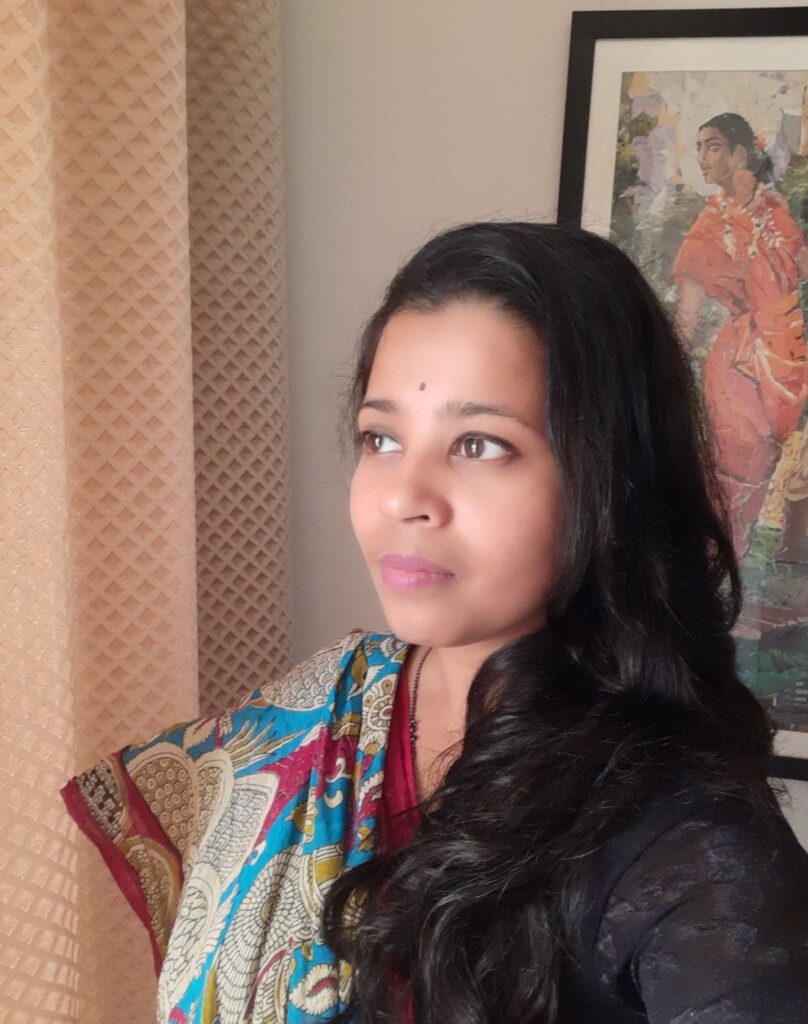
Written courtesy – Sharvaree Katdare and Moiz Mamoowala
Q1- Can you tell us a bit about your background and how you got started in both painting and textile art?
A1- I am a textile designer, painter and a qualified interior designer which adds value to my art on fabrics. My journey in painting and textile art began with a bold fusion of these materials and a desire to blend them with vogue.
Q2- What materials and techniques do you prefer to use in your textile art compared to your painting?
A2-I use a variety of mediums like oils and acrylics when I paint. For textiles, I prefer natural fabrics and conventional printing techniques, often bestowed with hand-painted elements.
Q3- How do you plan to connect your paintings with the world of fashion?
A3- I aim to twirl my paintings into textile designs, inventing rare prints for fashion. By mingling my imaginative vision with fabric design, I want to concoct couture that bouts my art and begets palpitations in fashion.
Q4- How did you balance family responsibilities with pursuing your art?
A4- After marrying, I undertook my onuses and upthrust two children while working on my art at night. Despite challenges, I secured admission to a prestigious college like Sir J. J. School of Art. I completed my B.F.A textile balancing my responsibilities diligently. In my journey, there were times when I ambled solo, at phases I found my husband by my side, walking hand in hand, offering his support.
Q5- How did selling your first painting impact you?
A5- My first painting was sold for Rs. 45,000 in 2012 was significant to boost my confidence, validate my efforts and motivate me to continue.
Q6- How do you see yourself as a global painter?
A6- I see myself as a global painter by blends diverse artistic influences while incorporating conspicuous Indian flavours into my work. This permutation acknowledges me to cartel with a wide scion and patron idiosyncratically to the unanimous art fraternity. Given an opportunity, I would like to cavalcade my art in numerous other countries.
Q7- How has studying Jainism affected your art?
A7- Jainism has deeply influenced my art by introducing me to its simplicity, non-violence, and intricate symbolism principles. These constituents have stimulated me to embrace leitmotifs of coherence and scrupulous tessellations into my oeuvre, elevating my artistic mien, cultural accretion and philosophical gravity. I have also drudged on other foci in the past like Swara, Kamasutra, Motherhood, Womanhood, and Navrasa apart from Jainism and will endure the work in my imminent new ideas.
Q8) As a painter what is your best genre for painting?
A8- I began reading and accepting the diverse styles of many painters, among the Indian painters, the paintings of Shri Raja Ravi Verma, K. K. Hebbar, A. A. Almelkar, charmed me a lot and painters outside India, like Van Goh, Monet & Picasso etc. When I understood the folk art of India, I found myself in it. In my paintings, one can notice a new style I have originated with a foretaste of the myriad folk art of India.